If you’re planning insulation work on your Denver home, the Xcel Energy rebate program can return real money to your pocket. In some cases well over $1,000 for a single project, and significantly more when you combine multiple measures. The amounts vary based on which measures you install, your home’s current insulation levels, and whether you qualify for stacking bonuses. This post breaks down every rebate tier available in 2025-2026, with a real-world example built around a typical Front Range home.
For the complete program overview and eligibility requirements, see our Xcel energy rebates Denver CO guide. For a deeper look at how the Whole Home Efficiency bonus stacks on top of the base amounts shown here, see our post on the Xcel energy Whole Home Efficiency bonus in Denver.
What Are the 2026 Xcel Energy Insulation Rebate Amounts?
Denver homeowners can receive up to $1,250 for attic insulation, up to $1,000 for air sealing, and up to $875 for wall insulation, with a 25% Whole Home Efficiency bonus added when three or more measures are completed within two years.
These are the verified rebate amounts currently available through Xcel Energy’s residential insulation program in Colorado. All dollar figures represent maximum amounts. Actual rebates depend on your home’s square footage, current insulation levels, and whether all pre-condition and post-condition requirements are met.
| Measure | Pre-Condition Required | Post-Condition Required | Max Rebate |
|---|---|---|---|
| Attic insulation | Existing level R-24 or below (gas-heated home) | Final level R-60 or higher | Up to $1,250 |
| Air sealing | Leaky building envelope (blower door test required) | 20% or greater CFM50 reduction verified by blower door | Up to $1,000 |
| Wall insulation | Empty wall cavities, no existing insulation | Dense-pack to R-13 or higher | Up to $875 |
| Heat pump bonus | Qualifying insulation installed before heat pump | Heat pump installed after insulation completion | $600 |
| Whole Home Efficiency (WHE) bonus | 3 or more qualifying measures within 24-month window | All measures meet individual post-conditions | 25% added to combined base rebates |
How Much Is the Attic Insulation Rebate?
The attic insulation rebate pays up to $1,250 when you upgrade from R-24 or below to R-60 or higher in a gas-heated Denver home.
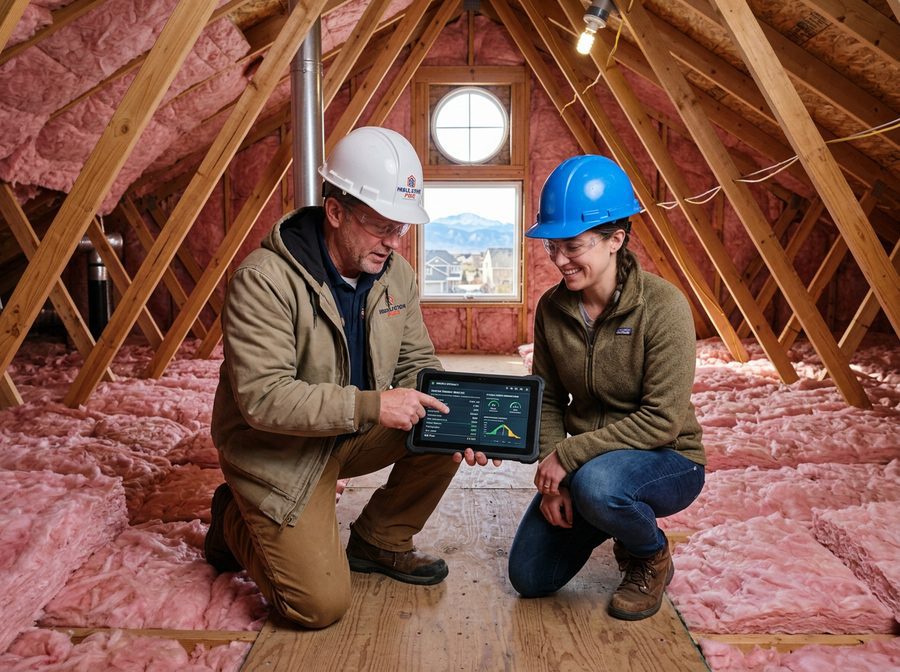
Attic insulation is the highest-value individual rebate measure available to gas-heated Denver homeowners. If your current attic insulation is at R-24 or below, the case in a large share of homes built before 1990, and the completed project brings you to R-60 or higher, you qualify for up to $1,250 back from Xcel.
The actual rebate amount scales with the area being treated, so larger attic footprints generally yield higher rebate amounts, up to the published maximum. Most Denver homes fall into the 800-to-1,400 square foot attic range, which puts them well within striking distance of the maximum on a full-depth attic job.
Blown-in insulation, cellulose or fiberglass, is the standard approach for this measure. It fills around existing obstructions like joists and blocking without gaps, and it’s the most practical way to bring an underinsulated Denver attic up to current performance standards. For more on what the installation looks like, see our attic insulation service page.
We inspected a 1978 ranch in Arvada last month. Attic was sitting at R-9. The homeowner had no idea. That’s $1,250 from Xcel sitting unclaimed. We finished the attic job in one day, submitted the paperwork the following morning, and the rebate was on its way.
How Much Is the Air Sealing Rebate?
The air sealing rebate pays up to $1,000 when a professional blower door test confirms a 20% or greater CFM50 reduction after sealing.
Air sealing is the second-largest rebate measure available and one of the most impactful upgrades for Denver’s climate, where cold winters create significant heating losses through gaps, bypasses, and penetrations in the building envelope. The rebate requires a professional blower door test before and after the work to document at least a 20% CFM50 reduction.
For homes built before 2000, which describes much of the Denver metro’s existing housing stock, achieving the 20% reduction threshold is not difficult. Older homes tend to have substantial air leakage through attic bypasses, around plumbing and electrical penetrations, at rim joists, and through other unsealed pathways. A professional air sealing job addresses these systematically.
As BPI-certified contractors, we know exactly what Xcel’s auditors look for in a blower door test. We don’t guess at CFM50 numbers, we measure twice and submit clean data. That accuracy is what gets the air sealing rebate approved on the first submission.
The air sealing rebate pairs naturally with attic insulation because the most significant air leakage pathways in Denver homes are often in the attic. If you’re doing attic insulation anyway, adding air sealing on the same visit is frequently the most practical combination. Visit our air sealing service page for more detail on what’s involved.
How Much Is the Wall Insulation Rebate?
Homes with empty wall cavities can qualify for up to $875 for adding dense-pack insulation to R-13 or better.
Homes with empty wall cavities, a very common condition in Denver housing built before 1980, can qualify for up to $875 for adding dense-pack insulation. The pre-condition is empty walls with no existing insulation; the post-condition is R-13 or better throughout the treated cavity area.
Dense-pack installation is done without removing drywall in most cases. Small-diameter holes are drilled into each wall cavity bay at the top, specialized equipment forces cellulose or fiberglass tightly into the cavity, and the holes are patched and painted over. The process is minimally disruptive compared to a full wall tearout, and the thermal and acoustic improvement is substantial.
Not all homes have empty walls, some Denver homes from the 1970s have partial or inadequate insulation in the cavities, which may or may not qualify depending on the existing condition. We check this during your free estimate.
How Does the $600 Heat Pump Bonus Work?
Xcel pays an additional $600 bonus rebate when qualifying insulation work is completed before a heat pump is installed. The reasoning is practical: a well-insulated home can be heated and cooled by a smaller, more efficient heat pump. Getting the envelope right first improves the economics of the heat pump investment and reduces the equipment’s operating hours over time.
The $600 heat pump bonus is completely separate from, and stackable with, the Whole Home Efficiency bonus. You don’t need to be enrolled in WHE to earn it, and earning it doesn’t affect your WHE calculation. For homeowners combining insulation with a heat pump upgrade, this $600 comes on top of everything else they’re already receiving.
The sequencing matters, though. Insulation must be installed and verified before the heat pump is put in. Getting the order backward disqualifies the bonus.
What Is the Whole Home Efficiency Bonus and How Much Is It?
The Whole Home Efficiency bonus is the most powerful stacking mechanism in the Xcel rebate program. Complete three or more qualifying energy efficiency measures within a 24-month period and you receive an additional 25% added on top of your combined base rebates.
For homeowners doing attic insulation, air sealing, and wall insulation, three qualifying measures, the WHE bonus represents a substantial add-on. At $2,500 in base rebates, the 25% bonus adds another $625. At $3,000 in base rebates, the bonus adds $750. The measures don’t all have to be done at once. You can stage them within the two-year window, which gives homeowners flexibility to spread costs across budget cycles.
For a full breakdown of how to plan and sequence your measures to maximize the WHE bonus, see our post on the Xcel energy Whole Home Efficiency bonus in Denver.
Real-World Example: 1,500 Square Foot Denver Home
Here’s how the math works for a realistic Denver project, a 1,500 square foot home built in the 1970s, gas heated, with an attic at R-11, empty wall cavities, and measurable air leakage.
| Measure | Example Rebate Amount | Notes |
|---|---|---|
| Attic insulation (R-11 to R-60+, approx. 1,100 sq ft attic) | $1,100 | Below $1,250 max; scales with attic area |
| Air sealing (blower door confirms 26% CFM50 reduction) | $850 | Below $1,000 max; based on scope and reduction achieved |
| Wall insulation (empty cavities, approx. 900 sq ft of exterior wall) | $750 | Below $875 max; scales with wall area treated |
| Subtotal, base rebates (3 measures) | $2,700 | |
| WHE 25% bonus (3 qualifying measures completed) | $675 | 25% added to $2,700 base total |
| Total rebates, insulation only | $3,375 | Before any heat pump bonus |
| Optional: heat pump bonus (if heat pump installed after insulation) | $600 | Separate from WHE; stackable |
| Grand total with heat pump bonus | $3,975 | Subject to Xcel program caps and verification |
This example is based on representative numbers and current program rates. Actual rebate amounts depend on your home’s specific measurements and conditions, Xcel’s current program schedule, and full compliance with all measure requirements.
How Does Rebate Stacking Work in Practice?
Stacking means earning rebates on multiple measures in the same project or across projects within the qualifying window. There’s no penalty for doing this, the program is explicitly designed to reward homeowners who make multiple improvements. The key requirements are:
- Each measure must independently meet its pre-condition and post-condition requirements
- The WHE 25% bonus requires at least three qualifying measures within a 24-month window
- The $600 heat pump bonus is a separate incentive; it doesn’t count as one of the three WHE measures in the same calculation
- Pre-approval is required if total expected rebates for a project exceed $5,000
- All work must be performed by an Xcel-enrolled Trade Ally contractor
At Insulation Nation, we help customers plan their measure sequence from the start so they don’t accidentally miss a bonus or fail to meet a pre-condition requirement. We’ve worked with homeowners across the Denver metro who came in expecting a $500 rebate and left with more than $2,000 once we helped them understand how the measures could be combined.
Frequently Asked Questions About Xcel Rebate Amounts
What is the maximum Xcel Energy insulation rebate a Denver homeowner can receive?
The maximum standard rebate for a single insulation project combining attic insulation ($1,250), air sealing ($1,000), and wall insulation ($875) totals $3,125 before the Whole Home Efficiency bonus. Add the 25% WHE bonus and the total reaches approximately $3,906. With the optional $600 heat pump bonus stacked on top, the maximum combined rebate can approach $4,500 on a large project that qualifies for every measure. Insulation Nation’s average customer receives around $1,600.
Do Xcel rebate amounts change from year to year?
Xcel can adjust rebate amounts, add new measures, or close measures when program funding runs low. The 2025-2026 amounts shown in this post are verified current figures, but they are subject to change. We recommend calling Insulation Nation at (720) 410-9414 before scheduling work so we can confirm current program availability and amounts for your specific project.
Do the Xcel rebate amounts scale with the size of my home?
Yes, for most measures the rebate amount scales with the area treated, up to the published maximum. A larger attic with more square footage to insulate generally yields a higher rebate than a smaller one, as long as all pre-conditions and post-conditions are met. The published figures are per-measure maximums, not flat rates for all homes regardless of size.
Can I get the full $2,250 rebate in a single project?
Yes. Combining attic insulation (up to $1,250) and air sealing (up to $1,000) in a single project can reach $2,250 in base rebates before any bonus. To hit this number, your home’s attic must qualify at R-24 or below, the attic work must reach R-60 or higher, and the air sealing must achieve at least a 20% CFM50 reduction verified by a blower door test. Insulation Nation can assess your home’s eligibility on a free estimate visit.
Get Your Rebate Estimate, Free
Want to know exactly what your Denver home qualifies for? Insulation Nation is an Authorized Xcel Energy Trade Ally, BBB Accredited, BPI Certified, and rated 4.9/5 on Google. We’ve insulated over 2,000 homes across the Front Range and handled every rebate application on behalf of our customers, they fill out zero paperwork.
Call us at (720) 410-9414 to schedule your free estimate. We assess your current insulation levels, confirm eligibility for each measure, and give you a projected rebate calculation before you commit to anything. Most estimates take about an hour.
You can also reach us through our Xcel Energy rebates page or directly via our contact page. Our average customer receives $1,600 back from Xcel. Some projects return up to $2,250. Call (720) 410-9414 and let’s find out where yours lands.