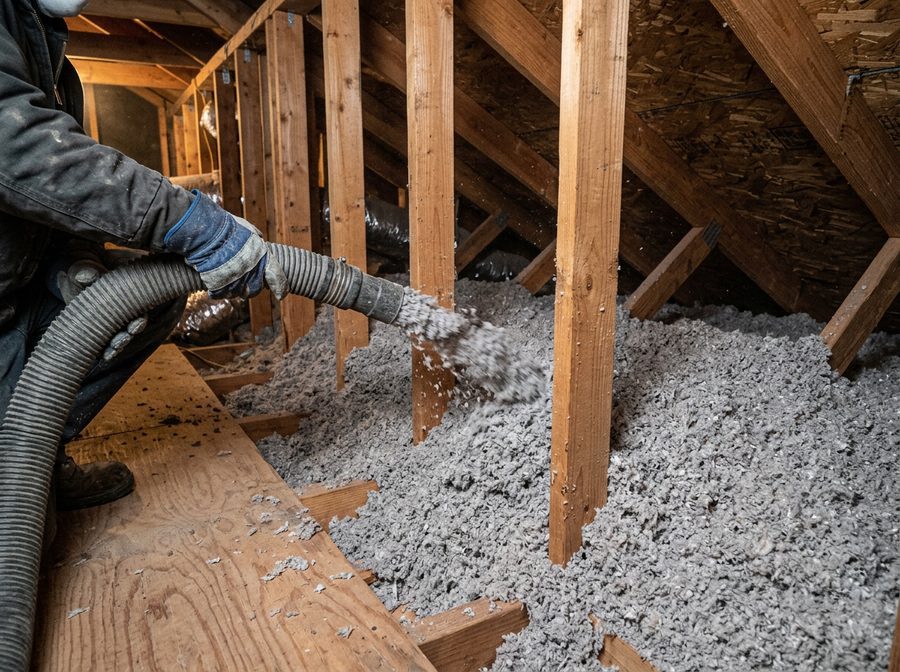
Blow-in insulation – also called loose-fill insulation – is the most common type of attic insulation installed under the Xcel Energy rebate program across the Denver metro. It fills irregularly shaped attic spaces without gaps, achieves consistent R-values across the entire attic floor, and installs quickly on most residential attics. When it comes to qualifying for Xcel’s up to $1,250 attic rebate, blow-in is what the large majority of Denver homeowners end up using.
But not every blow-in project qualifies automatically, and not every variation of blown-in material is treated exactly the same way under the program. This post covers the specific R-value and air leakage requirements that apply to all qualifying blow-in projects, explains the practical differences between cellulose and fiberglass loose-fill, addresses where spray foam fits (and doesn’t fit) in the rebate picture, and walks through the “topping off” scenario that causes more confusion – and more denied applications – than almost any other situation we see.
For the full overview of everything available under the Xcel rebate program, visit our Xcel energy rebates Denver CO guide.
What Are the R-Value Requirements for Qualifying Blow-In Attic Insulation?
Your attic must measure R-24 or below before the project and R-60 or higher after – these thresholds apply regardless of whether you use cellulose, fiberglass, or any other qualifying material.
The rebate requirements for blow-in attic insulation are the same as for any other qualifying insulation type. The material doesn’t change the thresholds – the performance targets are fixed regardless of what goes into the attic:
- Pre-job R-value: R-24 or below. Your existing attic insulation must measure at or under R-24 before the project begins. This is documented by the contractor before work starts – not estimated from memory, not approximated from installation records. An actual measurement of the current installed depth and calculated R-value.
- Post-job R-value: R-60 or higher. After blow-in is complete, the total attic R-value across the full attic floor must reach R-60 minimum. We confirm this with depth probes placed at multiple points throughout the attic at the time of installation.
- Air leakage reduction required alongside insulation: A blower door test is conducted before and after the combined project. The attic insulation rebate requires that air sealing was performed alongside the blow-in work – the post-job test must show improvement in CFM50 compared to the pre-job baseline. This requirement applies regardless of insulation material type.
These three requirements apply equally to cellulose blow-in, fiberglass blow-in, or any other qualifying loose-fill product.
From the Field: How Cellulose Settling Affects the Xcel Audit
Cellulose is what we install in most Denver attics. It settles about 10-15% over time, which we account for in our depth calculation. When Xcel’s auditor shows up, the R-value is where we said it would be. We install to a depth that anticipates settling – so if the project spec calls for R-60, we install to a depth that delivers R-65 to R-68 at the time of installation, knowing it will settle to R-60 or above. That’s not padding – it’s how you guarantee the post-job audit passes. We’ve seen projects from other contractors fail Xcel’s audits because they installed to the nominal depth without accounting for settling, and the follow-up measurement came in at R-54 or R-56. Those homeowners had to bring a contractor back out to top off before the rebate would clear.
Cellulose vs. Fiberglass Blow-In: What Is the Difference for Xcel Rebates?
Both cellulose and fiberglass blow-in qualify for Xcel’s rebate program. The difference is in R-value per inch and settling characteristics – cellulose is denser and needs less depth, fiberglass is more moisture-resistant and more widely stocked in Denver.
When Denver homeowners hear “blow-in insulation,” they often don’t realize there are two distinct materials commonly used in this application. Both qualify for Xcel’s rebate program. The choice between them depends on your specific attic conditions, installer availability, and occasionally homeowner preference.
Blown-In Cellulose
Manufactured from recycled paper (usually post-consumer newsprint) treated with a borate compound that provides fire resistance and deters pests. Cellulose provides a slightly higher R-value per inch compared to standard blown fiberglass – approximately R-3.2 to R-3.8 per inch depending on settled density. It fills irregular spaces well, tends to stay in place once it’s settled, and has a lower embodied energy profile than fiberglass. Cellulose qualifies for Xcel’s rebate program when the R-value and air leakage requirements are met.
Blown-In Fiberglass
Made from spun glass fibers, typically in a loose, lightweight form that’s blown into attic spaces at relatively low pressure. Fiberglass provides a slightly lower R-value per inch than cellulose – approximately R-2.2 to R-2.7 per inch – but is highly resistant to moisture absorption and settles less over long periods. Fiberglass blow-in is a common attic insulation material we install in Denver because of its wide availability, long-term dimensional stability, and predictable performance. Fiberglass blow-in qualifies for Xcel’s rebate program when the R-value and air leakage requirements are met.
Either material will get you to the R-60 target Xcel requires. Cellulose needs less depth to reach R-60 (roughly 16 to 19 inches depending on density). Fiberglass needs more depth to achieve the same R-value (roughly 22 to 27 inches at standard blown density). Both are installed quickly on most residential Denver attics.
Insulation Types and Rebate Eligibility
| Insulation Type | Approx. R-Value Per Inch | Qualifies for Attic Rebate? | Notes |
|---|---|---|---|
| Blown-in fiberglass (loose-fill) | R-2.2 to R-2.7 | Yes | Most common in Denver attic installations |
| Blown-in cellulose (loose-fill) | R-3.2 to R-3.8 | Yes | Higher density, fills irregular spaces well |
| Fiberglass batts | R-3.1 to R-4.3 | Yes, with correct installation | Air sealing component harder to achieve; less common for retrofit |
| Open-cell spray foam (attic floor application) | R-3.5 to R-3.7 | Conditional | Application-specific; call us before proceeding with spray foam |
| Closed-cell spray foam (attic floor) | R-6.0 to R-7.0 | Conditional | High cost vs. same rebate as blow-in; rarely the best financial choice |
| Mineral wool blown-in | R-3.0 to R-3.3 | Yes | Less common in Denver; qualifies when R thresholds are met |
Where Does Spray Foam Fit in the Xcel Rebate Picture?
Spray foam can qualify in specific attic floor configurations, but it costs significantly more than blown-in for the same maximum rebate. In most Denver attic projects, blown-in delivers better net economics.
Spray foam comes up in almost every consultation on attic insulation, and the question is always essentially the same: “Should I use spray foam instead of blow-in, and does it get a better rebate?”
Open-cell spray foam applied to the attic floor assembly – between and over the joists, similar to how blow-in is installed – can qualify for the rebate in specific configurations. Open-cell foam provides built-in air sealing as it’s installed. However, if open-cell foam is instead applied to the underside of the roof deck (creating an “unvented attic” or “hot roof”), the application is fundamentally different and may not qualify for the attic insulation rebate under Xcel’s current program structure. If spray foam is part of your plan, discuss the specific application with us before any work is contracted.
Closed-cell spray foam provides a higher R-value per inch (R-6 to R-7) and excellent air sealing. But it costs significantly more per square foot than blown-in fiberglass or cellulose. The Xcel rebate is a fixed maximum of $1,250 regardless of which qualifying material you use – so spending $7,000 to $10,000 on closed-cell spray foam for an attic floor when blown-in at $3,000 to $4,000 qualifies for the same rebate rarely makes financial sense.
At Insulation Nation, we recommend blown-in for most Denver attic installations for exactly this reason: it reliably qualifies, achieves the required R-60, and offers the best net cost after the rebate is applied.
What Does “Topping Off” Existing Blow-In Mean for Rebates?
“I already have some blow-in in my attic – can I just add more on top and get the rebate?”
This is one of the most common questions we get, and the answer depends entirely on what the current R-value measures at today:
- If your existing blow-in currently measures R-24 or below: Yes, you can add on top and qualify for the rebate, as long as the post-job total reaches R-60 and the air sealing and blower door requirements are met. The key is that we measure the actual current depth – not the original installed amount.
- If your existing blow-in currently measures R-25 or above: No. You do not qualify for the attic insulation rebate, regardless of how much additional material you add on top. The pre-job threshold is a hard cutoff.
This is where the physical reality of blow-in matters. Both fiberglass and cellulose settle over time. Fiberglass can lose 20 to 30 percent of its originally installed R-value through settling over 10 to 15 years. Cellulose settles somewhat less but still compresses over time. An attic that was installed to R-38 in 2005 may measure R-28 or lower today – potentially qualifying for the rebate even though the original installation was above the current threshold.
We measure what’s actually there, not what the original installation record says. That measurement determines eligibility.
Installed Cost Ranges for Denver Attic Projects
Cost varies based on attic size, accessibility, existing insulation depth, and the scope of air sealing needed. For a project going from minimal insulation up to R-60, including air sealing and blower door testing:
- 1,000 sq ft attic: Approximately $1,800 to $2,800 installed
- 1,500 sq ft attic: Approximately $2,600 to $4,000 installed
- 2,000 sq ft attic: Approximately $3,200 to $5,200 installed
After the Xcel rebate of up to $1,250, these net costs represent a project that pays back through energy savings within 3 to 7 years, with 30+ years of ongoing savings after that. The rebate amount is the same whether the attic is 900 or 2,200 square feet, so larger attics benefit somewhat less in percentage terms but receive the identical dollar rebate.
Why Blow-In Is the Preferred Choice at Insulation Nation
We’ve insulated more than 2,000 homes across the Denver metro, and blown-in insulation wins on nearly every factor that matters for a standard attic installation:
- It fills the entire attic floor – including around joists, blocking, existing batts, and HVAC equipment – without the gaps that batts leave at edges and corners.
- It covers whatever existing conditions are present: settled old batts, partial fill jobs, or completely bare joists.
- Combined with proper air sealing, it consistently produces the 20% CFM50 reduction Xcel’s program requires.
- Installation is fast – most residential attics are completed in a single day.
- Material cost is substantially lower than spray foam options, meaning a higher percentage of the rebate translates to net savings rather than cost offset.
For more detail on the attic insulation rebate process, visit our attic insulation rebate guide. For the full list of current rebate amounts across all qualifying measures, see our 2026 Xcel rebate amounts guide.
Find Out What Your Attic Qualifies For
If your attic is at R-24 or below – or if you’re simply not sure what it’s at right now – a free assessment from Insulation Nation gives you a definitive answer. We measure the existing insulation, inspect the air sealing needs, and provide a complete project quote with the expected rebate amount. No obligation, no guesswork.
Visit our blow-in insulation page for more detail on how the installation process works, then call us to schedule your assessment.
Call (720) 410-9414 – Insulation Nation handles every step from assessment through rebate submission. Serving Denver and 40+ Front Range communities. Authorized Xcel Energy Trade Ally. 4.9/5 Google rating. BPI Certified. BBB Accredited.
Questions about whether your specific attic qualifies? Call (720) 410-9414 and we’ll walk through the R-value requirements with you and tell you exactly where your home stands before anything is scheduled.