The Xcel Energy wall insulation rebate offers up to $875 for Denver homeowners, but it comes with one requirement that rules out a lot of homes right at the start: the exterior wall cavities must be completely empty before the project begins. No partial fills. No old, degraded insulation. No “just a little bit from the original construction.” Completely empty.
If your home meets this condition, this is meaningful money back for a project that produces a real and noticeable change in comfort – especially in Denver’s shoulder seasons, when outdoor temperatures swing from the low 20s overnight to 55°F or higher by afternoon and your walls are one of the primary paths for that temperature change to reach the interior. This post covers exactly who qualifies, how the contractor verifies empty cavities, what installation materials can be used, and why partial fills are excluded no matter what.
For a full list of all Xcel rebates available to Denver homeowners, the Xcel energy rebates Denver CO guide is the best place to start before making any project decisions.
What Is the Core Requirement for the Xcel Wall Insulation Rebate?
The wall cavities must be completely empty – zero insulation, no partial fills, no degraded batts – before the project begins. Any existing material in the cavity disqualifies that section of wall.
Xcel’s wall insulation rebate is built around a specific energy impact: going from no insulation to R-13 or higher in a previously uninsulated wall assembly. That improvement is large enough to justify the rebate. Going from R-3 (some degraded original batt) to R-13 is a smaller improvement – the program doesn’t subsidize that increment, so partial fills don’t qualify regardless of starting point.
This means the pre-job condition must be:
- Exterior wall cavities with zero insulation – nothing in the stud bays at all
- No prior partial fills, top-offs, or injection jobs from previous projects
- No existing batts, even if degraded, compressed, or falling out of place
There’s no “mostly empty” exception. If a probe or thermal scan reveals any material in a cavity, that portion of the wall doesn’t qualify. A contractor who tells you otherwise is either wrong about the program requirements or hasn’t read them recently.
From the Field: Walls That Look Updated but Have Zero Insulation
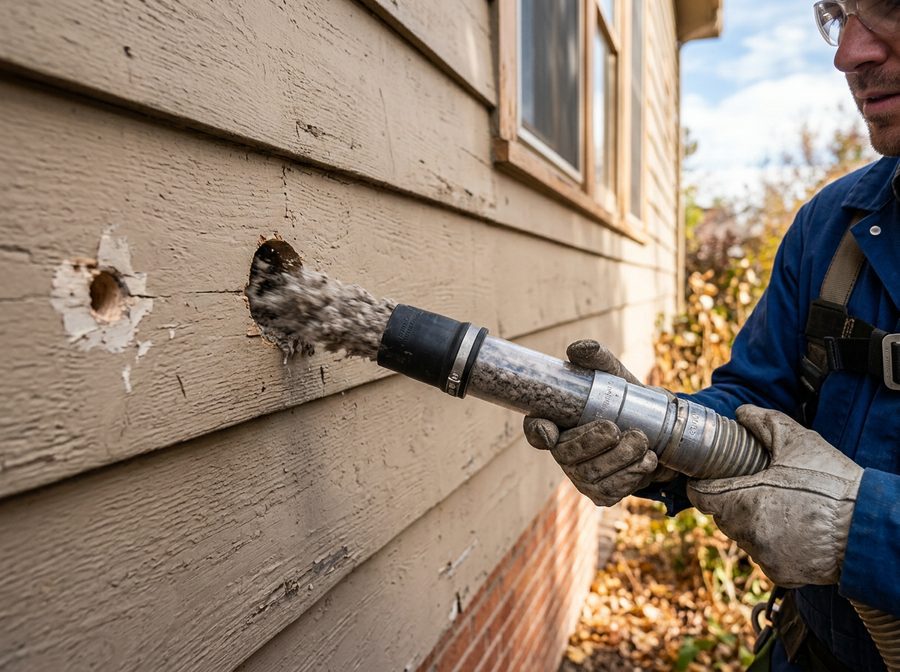
Empty wall cavities are more common than people think. We’ve been in homes that look completely updated – new paint, renovated kitchen – with walls that have zero insulation. We verified it with a thermal camera. That’s a $875 rebate sitting in the walls. In one Lakewood house we assessed last spring, the homeowner had just finished a $40,000 kitchen remodel and had no idea the exterior walls adjacent to the new cabinets were completely uninsulated. The thermal scan showed it immediately: cold strips running floor to ceiling right next to the brand-new cabinetry. We dense-packed the cavities, submitted the documentation, and the $875 rebate came through six weeks later.
Which Denver Homes Typically Have Empty Wall Cavities?
The homes most likely to have uninsulated exterior walls in the Denver metro are construction from between the early 1950s and early 1970s. During that period, wood-frame construction in Colorado routinely omitted wall cavity insulation entirely. Energy code requirements for residential wall insulation didn’t exist in a form that would have mandated it, heating fuel costs were low, and insulation wasn’t a standard selling point in spec home construction the way it became after the energy shocks of the mid-1970s.
Homes built before 1975 in Denver that have no documented insulation upgrades on record have a reasonable probability of having empty wall cavities. Common candidates in the Denver metro include:
- Ranch-style homes from the 1950s and 1960s in Wheat Ridge, Lakewood, Arvada, Englewood, and Littleton
- Post-war bungalows in older Denver neighborhoods such as Park Hill, Montbello, Westwood, and Barnum
- Cape Cod and split-level homes from the early 1960s throughout Aurora and the first ring of Denver suburbs
- Original construction homes in older mountain communities along the Front Range where post-war construction patterns are similar
Homes built after the mid-1970s are less likely to have empty cavities, but it’s not uncommon – especially in lower-cost spec construction from the late 1970s and early 1980s. The only way to know for certain is to have a contractor verify before any money changes hands. We do that as a standard part of our free home assessment.
How Does a Contractor Verify Empty Wall Cavities?
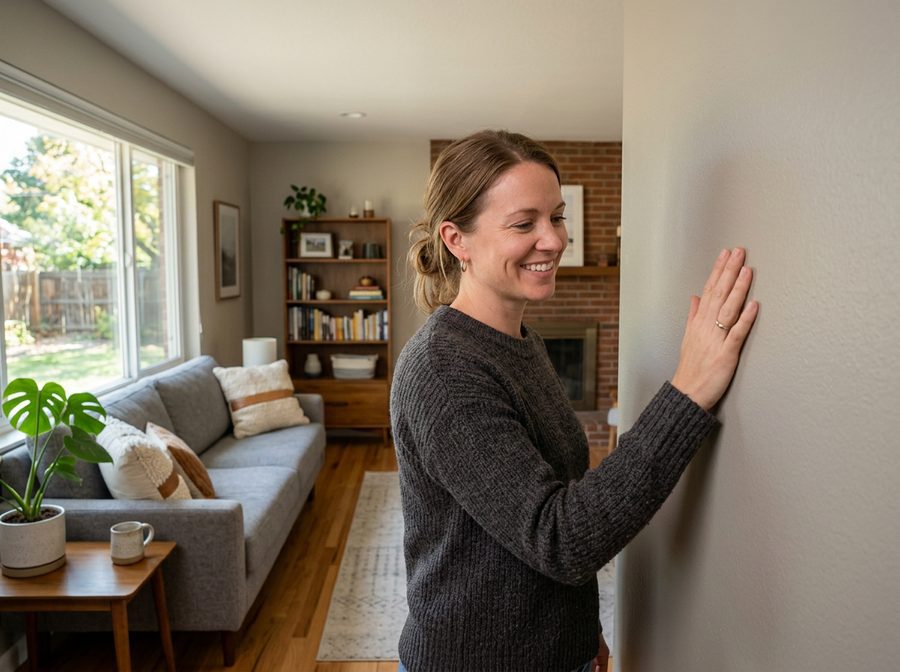
Verification is done with thermal imaging and physical probes – not based on a homeowner’s word. The rebate application requires documentation that holds up to Xcel’s review. We use a combination of methods depending on what gives the clearest picture for a specific home:
- Thermal imaging (infrared scanning): An infrared camera scan of exterior walls on a cold day with the heat running shows clear temperature differentiation between insulated and uninsulated cavities. Insulated stud bays retain more heat and show up distinctly from empty ones. This is non-invasive, fast across an entire exterior, and highly accurate when conditions are right.
- Physical probe inspection: In some cases, we make a small probe hole in an inconspicuous location – inside a closet wall, behind a built-in shelf, or at the base of an exterior wall – to directly confirm whether the cavity contains any material. The hole is plugged and patched after inspection.
- Building permit and history review: For homes where permit records are accessible through Denver, Jefferson, Arapahoe, or Adams County, prior insulation work sometimes shows up in the permit history. If a blown-in job was done 15 years ago, it shows in the record, and the walls don’t qualify.
If we find any existing insulation during this verification process, we tell you directly and immediately. There are still other rebate opportunities available (attic insulation, air sealing), and we’ll walk you through what does and doesn’t apply to your home’s specific conditions. Being BPI-certified means we approach cavity verification the same way an Xcel auditor would – thermal documentation, probe results, and permit records all go into the project file before any installation is quoted.
What R-Value Must Wall Insulation Reach After Installation?
After installation, the wall insulation must achieve R-13 minimum. For standard 2×4 framing – the most common dimension in the era of homes that typically have empty cavities – a completely filled cavity using dense-pack blown-in fiberglass or cellulose achieves between R-13 and R-15.
After installation, the wall insulation must achieve R-13 minimum throughout the treated exterior wall area. For standard 2×4 stud-framed walls, a completely filled cavity using dense-pack blown-in fiberglass or cellulose achieves between R-13 and R-15. Homes with 2×6 framing can reach R-19 or higher, but 2×6 framing wasn’t common until the mid-1980s in most Denver residential construction.
R-13 in a wall is substantially lower than the R-60 target for attics, but that’s expected – walls have a fixed cavity depth governed by the framing dimension. You can’t add more depth without a major renovation. The rebate is calibrated to reward the practical maximum improvement for the existing framing.
Wall Insulation Types and Rebate Eligibility
| Insulation Type | Typical R-Value (2×4 cavity) | Qualifies for Rebate? | Notes |
|---|---|---|---|
| Dense-pack blown-in fiberglass | R-13 to R-15 | Yes | Most common for Denver retrofit wall jobs |
| Dense-pack blown-in cellulose | R-13 to R-15 | Yes | Good performance in irregular cavities |
| Fiberglass batts (open-wall installation) | R-11 to R-15 | Yes, if full cavity fill is achieved | Requires wall opening; less common in retrofit |
| Open-cell spray foam | R-13 to R-14 | Conditional, must fully fill cavity | Higher material cost; verify application with Trade Ally |
| Closed-cell spray foam | R-18 to R-21 | Conditional | Cost premium significant; confirm qualification before proceeding |
| Partial fills (any material) | Varies | No | Partial installs do not qualify regardless of material or depth |
Why Are Partial Wall Fills Excluded from the Rebate?
Partial fills don’t qualify because the energy improvement is too small. Xcel’s program is built around the full R-13 improvement – going from zero to fully insulated – not incremental top-ups.
It comes up regularly: can we insulate just the north-facing walls? Just the master bedroom exterior wall? Just the first floor? Xcel’s program requires that the entire exterior wall assembly being treated is brought to R-13 or higher. A partial wall fill leaves the untreated areas as the dominant heat loss path – the energy improvement falls below the threshold the program is designed to achieve.
This also applies to scenarios where one section of a wall has prior insulation and another doesn’t. Even if the previously insulated section is small or was done long ago, the presence of any existing material in any part of the cavity disqualifies it from the rebate. This is why verification matters – we need to know the actual condition of every wall area before committing to a scope.
How to Know If Your Walls Qualify
A free assessment is the fastest path. We’ll inspect your exterior walls, give you a clear answer about cavity conditions, and tell you what the project would cost and what rebate you can expect – all before you make any commitment. No obligation, no pressure.
Signs that suggest your walls might be empty and worth checking:
- Your home was built before 1975 with no documented insulation upgrades in the permit history
- You notice that exterior walls feel noticeably cold to the touch on winter days
- Your heating bills are higher than comparable neighbors with similar home sizes
- A prior energy audit identified wall insulation as a missing element
- You’ve had plumbing or electrical work done in the walls and the contractor mentioned empty cavities
We also recommend checking our attic insulation rebate guide – many homes that qualify for wall insulation also qualify for the larger attic rebate, and completing both in the same project window puts you in position for the Whole Home Efficiency bonus. See also our air sealing rebate guide for how these measures combine.
What Does the Wall Insulation Process Look Like?
For most retrofit wall insulation projects in Denver, we use dense-pack blown-in insulation – either fiberglass or cellulose depending on the specific conditions we find during assessment. Here is the basic sequence:
- Cavity verification: Thermal scan and, if needed, a small probe to confirm cavities are completely empty before any materials are ordered or installed.
- Access hole creation: Small holes are drilled between each stud bay. Depending on the home’s exterior material and interior access, holes may be drilled from outside through the siding, or from inside through drywall in closets or utility spaces.
- Dense-pack installation: Material is blown in under controlled pressure using a fill tube that reaches the bottom of each cavity. The tube is withdrawn gradually as the material fills upward, creating a uniform, full-density pack that won’t settle or shift over time.
- Patch and finish: Exterior holes are plugged with matching plugs or caulk and finished to blend with the surrounding siding material. Interior holes are patched flush with existing drywall and ready for paint.
- Documentation and rebate submission: We photograph pre- and post-installation conditions, document the R-value achieved, and submit the rebate application to Xcel on your behalf.
Most wall insulation projects in a Denver home take one to two days, depending on the size of the exterior wall area, the accessibility of stud bays, and the exterior material. Brick and stucco exteriors require more care during drilling and patching compared to wood or vinyl siding, but both are standard for us.
Get Your Free Wall Insulation Assessment
If you own a pre-1975 Denver-area home and haven’t had a documented wall insulation project, there’s a reasonable chance you’re looking at an $875 rebate that hasn’t been claimed yet. The first step is a free assessment from Insulation Nation – we bring the thermal imaging equipment, verify cavity conditions, and give you a project scope and rebate estimate before any work is proposed.
Visit our air sealing page for related services, or reach out through our contact page to schedule your free assessment.
Call (720) 410-9414 – Insulation Nation serves Denver and 40+ Front Range communities. BPI Certified, BBB Accredited, 4.9/5 on Google from 2,000+ completed projects. Owner Josh and the team know Denver’s older housing stock and how to get the rebate done right.
Not sure if your walls qualify? There’s no way to know without checking. Call (720) 410-9414 and we’ll schedule a thermal scan and give you a straight answer – at no cost.