How Much Can You Really Save with Xcel Energy Rebates on Insulation in Denver, CO?
The Xcel Energy insulation rebate program sounds great on paper, but what does the actual savings look like for a real Denver homeowner? The short answer: more than most people expect. The longer answer depends on your home’s size, your starting insulation level, how many qualifying measures you complete, and whether you also claim the federal tax credit.
We ran the numbers for a Westminster homeowner with a 1,850 square foot attic at R-11. Attic insulation: $3,200 installed. Xcel rebate: $1,250. Air sealing: $1,100 installed. Xcel rebate: $1,000. Federal 25C credit on combined project: $1,200. She paid $1,850 out of pocket for a $4,300 job. Payback period: under two years on energy savings alone.
We calculate expected rebates before we start any job. Our BPI training means we measure existing R-values and CFM50 with instruments, not estimates – so the rebate numbers we quote are the ones Xcel approves.
In this post we walk through three real-world Denver home scenarios, show the math step by step for each one, and give you a clear picture of what your payback period looks like based on typical Denver utility savings data. Individual results will vary – that is why Insulation Nation offers free in-home estimates before you commit to anything.
What Drives Your Total Savings on an Insulation Project?
Three separate and distinct buckets determine your total savings from an insulation project in Denver.
- Xcel Energy rebate – paid by Xcel after work is complete and paperwork is approved, typically arriving 6 to 10 weeks after submission
- Federal 25C tax credit – 30% of qualifying material costs, up to $1,200 per year, claimed on your annual federal tax return
- Ongoing utility bill savings – lower heating and cooling costs that continue year after year for the life of the insulation
The first two reduce your upfront out-of-pocket cost. The third one builds over time and represents the real long-term financial return on your investment. Together, all three make insulation one of the highest-return home improvement projects available in the Denver market.
For a full breakdown of every Xcel rebate amount and current program requirements, see the Xcel energy rebates Denver CO guide.
Understanding the Xcel Rebate Amounts Before the Scenarios
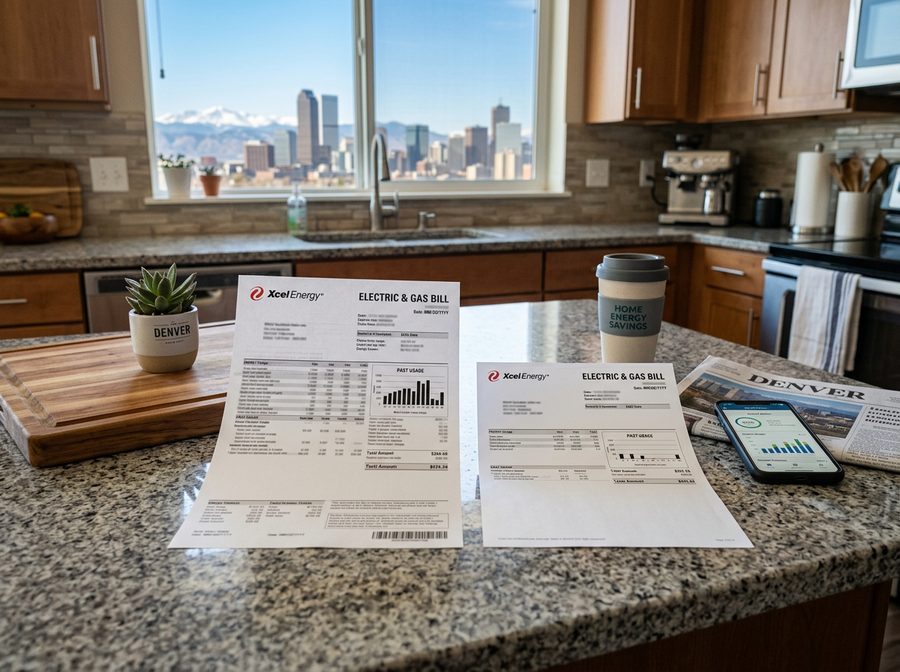
The Xcel Energy rebate amounts for insulation in 2025-2026 are:
- Attic insulation: Up to $1,250 – your attic must start at R-24 or below and finish at R-60 or higher
- Air sealing: Up to $1,000 – requires a blower door test confirming at least 20% CFM50 reduction
- Wall insulation: Up to $875 – empty wall cavity upgraded to R-13 or higher
- WHE bonus: 25% additional on base rebates when you complete 3 or more qualifying measures in one project
- Combined maximum: Up to $2,250 per the program’s current cap
The federal Section 25C credit adds another 30% of qualifying material costs, capped at $1,200 per year. That cap resets annually, which matters for larger projects that can be phased over two tax years.
Insulation Nation is an authorized Xcel Energy Trade Ally and handles all rebate paperwork. You fill out zero forms.
Scenario 1: Smaller Home, Attic Insulation Only (1,200 sq ft)
A 1,200 square foot ranch home in Lakewood has original insulation from the early 1980s sitting at R-11 in the attic. The homeowner wants a straightforward upgrade – blown-in insulation to R-60, nothing else.
Project scope: Attic insulation upgrade only
Estimated total project cost: $2,800
Estimated materials cost: $1,900 (relevant for federal credit calculation)
Step-by-step savings calculation:
- Xcel attic insulation rebate: $900 (based on home size and materials used)
- Federal 25C credit: 30% x $1,900 = $570 (under the $1,200 cap)
- Total upfront savings: $1,470
- Net out-of-pocket cost: $1,330
Ongoing utility savings analysis: A home this size with poor attic insulation in Denver’s climate typically saves $400 to $550 per year on heating and cooling after upgrading to R-60. Denver has roughly 6,000 heating degree days per year, and an under-insulated attic is responsible for 25 to 35% of a home’s heat loss. At an estimated $475 per year in savings, the net cost of $1,330 pays back in under 3 years. After that, the savings continue for the life of the insulation – typically 25 to 30 years – representing a total lifetime utility savings of roughly $10,000 to $15,000 on a relatively small investment.
Scenario 2: Mid-Size Home, Attic + Air Sealing (1,800 sq ft)
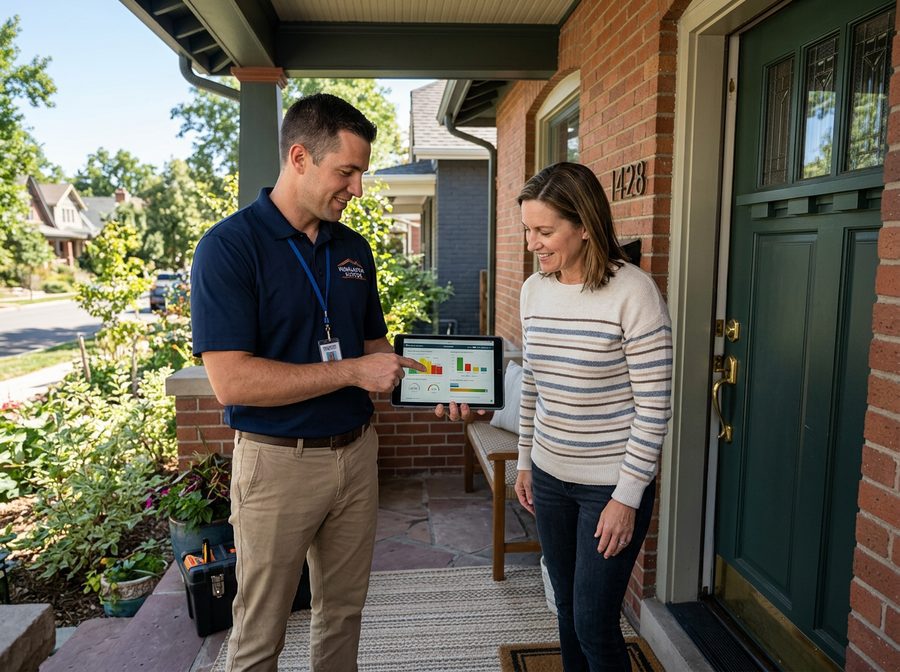
A 1,800 square foot two-story home in Aurora has R-19 in the attic and significant air leakage throughout the attic floor – common in Denver homes built in the 1990s. The homeowner wants both attic insulation upgraded to R-60 and full air sealing, with a pre- and post-blower door test to confirm performance and qualify for the air sealing rebate.
Project scope: Attic insulation upgrade + professional air sealing
Estimated total project cost: $4,500
Estimated materials cost: $3,000 (relevant for federal credit calculation)
Step-by-step savings calculation:
- Xcel attic insulation rebate: $1,250 (maximum, home qualifies at R-19 starting point)
- Xcel air sealing rebate: $800 (blower door confirmed 23% CFM50 reduction)
- Federal 25C credit: 30% x $3,000 = $900 (under the $1,200 cap)
- Total upfront savings: $2,950
- Net out-of-pocket cost: $1,550
Ongoing utility savings analysis: Adding air sealing alongside insulation typically increases utility savings by 20 to 40% compared to insulation alone. For a 1,800 sq ft home with significant prior leakage, combined insulation and air sealing can deliver $550 to $750 per year in heating and cooling savings. At an estimated $650 per year average, the net investment of $1,550 pays back in roughly 2.4 years. This scenario demonstrates why combining insulation and air sealing in one project is so financially compelling – the payback accelerates and the total lifetime savings are substantially higher than insulation alone.
Scenario 3: Larger Home, Multiple Measures + WHE Bonus Eligible (2,400 sq ft)
A 2,400 square foot home in Highlands Ranch has minimal attic insulation at R-13, empty wall cavities in two exterior-facing walls, and poor air sealing throughout. The homeowner wants to address all three areas in one project, which qualifies for the Whole Home Efficiency (WHE) 25% bonus that kicks in when three or more qualifying measures are completed together.
Project scope: Attic insulation + wall insulation + air sealing (3 qualifying measures)
Estimated total project cost: $9,500
Estimated materials cost: $6,200 (relevant for federal credit calculation)
Step-by-step Xcel rebate calculation:
- Attic insulation rebate: $1,250
- Wall insulation rebate: $875
- Air sealing rebate: $1,000
- Base rebate subtotal: $3,125
- WHE 25% bonus: $781
- Program cap applies – maximum combined rebate: $2,250
Note: The current Xcel Energy program caps combined rebates at $2,250 per project. Even when your calculated rebates plus WHE bonus exceed this cap, the payout is limited to $2,250. Always confirm current program caps with your Trade Ally contractor, as Xcel may update these amounts.
Full savings calculation using the $2,250 program cap:
- Xcel rebate (program cap): $2,250
- Federal 25C credit: 30% x $6,200 = $1,860 – but annual cap applies, so $1,200 for this tax year
- Total upfront savings: $3,450
- Net out-of-pocket cost: $6,050
Ongoing utility savings analysis: A full air sealing and insulation project on a 2,400 sq ft home in Denver can deliver $700 to $1,000 or more per year in utility savings, depending on how leaky and under-insulated the home was before the project. At $850 per year average, the net cost of $6,050 pays back in approximately 7.1 years. With the insulation lasting 25 to 30 years, that is still more than 20 years of pure savings – potentially $17,000 or more in total utility savings over the life of the improvement.
All Three Scenarios Compared Side by Side
| Scenario | Home Size | Measures Completed | Project Cost | Xcel Rebate | Federal 25C Credit | Net Out-of-Pocket | Est. Annual Savings | Payback Period |
|---|---|---|---|---|---|---|---|---|
| 1: Attic only | 1,200 sq ft | Attic insulation | $2,800 | $900 | $570 | $1,330 | $400–$550/yr | ~2.7 years |
| 2: Attic + air sealing | 1,800 sq ft | Attic insulation + air sealing | $4,500 | $2,050 | $900 | $1,550 | $550–$750/yr | ~2.4 years |
| 3: Attic + wall + air sealing | 2,400 sq ft | Attic + wall + air sealing | $9,500 | $2,250 | $1,200 | $6,050 | $700–$1,000/yr | ~7.1 years |
All figures are illustrative estimates based on typical Denver-area projects. Actual rebate amounts depend on your home’s starting conditions and current Xcel program limits. Utility savings vary by home, usage patterns, thermostat settings, and energy prices. Federal credit depends on your materials cost and tax liability. Consult Insulation Nation for a free estimate specific to your home, and a tax professional for guidance on the federal credit.
What Factors Affect How Much You Actually Save?
Your specific savings depend on several variables that shift real-world results up or down from the scenarios above.
- Starting R-value: The attic rebate requires you to start at R-24 or below. If your attic is already at R-25 or higher, the attic rebate is not available even if adding more insulation would still provide value.
- Home size and layout: Larger homes and homes with more complex attic geometry typically have larger project costs but also larger utility savings potential.
- Air leakage severity: The leakier your home is before the project, the more dramatic the savings from air sealing. Homes with ACH50 scores above 7 often see the biggest post-project utility bill drops.
- Number of qualifying measures: The WHE 25% bonus applies when three or more qualifying measures are completed in one project. Adding a third measure can meaningfully change your total rebate, though the program cap limits the maximum payout.
- Your tax situation: The 25C credit is non-refundable and has an annual cap. If your total tax liability is lower than the credit, you may not capture the full $1,200. A tax professional can tell you exactly how much of the credit you can use.
To see how the rebate interacts with the federal tax credit and get a full side-by-side comparison, read our post on the Xcel energy rebate vs federal tax credit in Denver CO. For the latest rebate amounts and current program rules, see our 2026 Xcel Energy rebate amounts guide.
How Insulation Nation Maximizes Your Rebate
Getting the maximum Xcel rebate requires documentation that starts before the first bag of insulation is installed. Pre-job photos, R-value measurements, blower door tests, and paperwork all need to happen in the right sequence and be submitted within 60 days of project completion.
As an authorized Xcel Energy Trade Ally, Insulation Nation manages this entire process. We check your existing conditions, confirm your rebate eligibility, complete the work to the required performance levels, run all required testing, and submit the full paperwork package to Xcel on your behalf.
Our customers receive an average of $1,600 in Xcel rebates per project. We have completed insulation work in 2,000+ Denver-area homes, hold BBB Accreditation and BPI Certification, and have a 4.9/5 Google rating. Explore our process on the attic insulation page to see what a project looks like from start to finish.
Get Your Real Numbers with a Free Estimate
The scenarios in this post show you what is possible, but your home’s actual numbers depend on your specific conditions, project scope, and what Xcel’s current program limits are at the time of your project. The best way to know exactly what you will save is to get a free in-home estimate from Insulation Nation.
During the estimate, we measure your existing insulation, check for air leakage, confirm your Xcel account eligibility, and give you a clear project cost and rebate estimate before you commit. There is no pressure and no obligation.
Call (720) 410-9414 to schedule your free estimate. We serve Denver and 40+ cities across the Colorado Front Range, including Lakewood, Aurora, Highlands Ranch, Englewood, Centennial, Littleton, Arvada, Westminster, Parker, Castle Rock, and more.
Ready to get started? Contact us online and we will get back to you quickly. Or if you want to talk through your specific home situation with someone who knows the Xcel rebate program inside and out, call (720) 410-9414. Josh and the team are here to help you understand what your home qualifies for and what the real numbers look like.