
Air sealing is one of the most cost-effective energy improvements a Denver homeowner can make, and Xcel Energy pays up to $1,000 for documented air sealing work in gas-heated homes. The program has a specific requirement that sets it apart from other rebates: you have to prove the work made a difference. That proof comes from a blower door test conducted before and after the project, showing at least a 20% reduction in measured air leakage.
This post explains what a blower door test actually measures, what CFM50 means in terms you can use, where air leaks typically originate in Denver homes, how air sealing and insulation work together to maximize your total rebate, and whether you can claim the air sealing rebate on its own without pairing it with insulation. For a complete overview of all available rebates, see our Xcel energy rebates Denver CO guide.
What Is a Blower Door Test?
A blower door is a calibrated fan that mounts in an exterior doorframe and depressurizes the house to 50 Pascals of pressure – the CFM50 reading tells you exactly how much air flows through every gap in the building envelope to equalize that pressure.
The fan either pressurizes or depressurizes the house to a standardized pressure differential (50 Pascals) and holds it there while a technician measures how much airflow the fan requires to maintain that pressure. That measurement is the CFM50 reading – cubic feet of air per minute at 50 Pascals of pressure.
Think of it this way: the blower door creates a controlled pressure difference between the inside and outside of your house, and the CFM50 number tells you how much air is flowing through every gap, crack, and penetration in the building envelope to equalize that pressure. A tighter house requires less airflow from the fan to hold the same pressure, meaning fewer and smaller gaps. A leaky house requires more airflow, meaning more total gap area.
For older Denver homes – anything built before about 1985 that hasn’t had air sealing work done – it’s common to see pre-project blower door readings in the 3,000 to 7,000 CFM50 range. After a thorough air sealing project targeting the attic, rim joists, and major penetrations, we typically see reductions of 20 to 40 percent on Denver homes. That range is enough to meet Xcel’s requirement and translates to real, measurable heating efficiency improvement.
Our BPI certification means we’re trained to run pre and post blower door tests to Xcel’s exact specification – not estimated, not eyeballed. Every reading we record is documented with calibrated equipment and submitted as part of the rebate application.
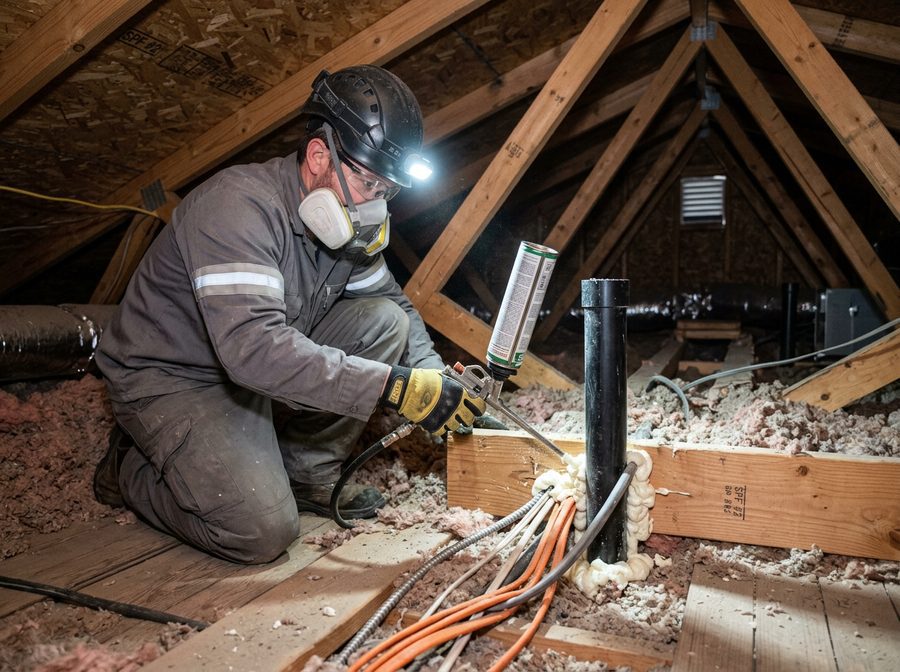
From the Field: A Westminster Home at 4,200 CFM50
The blower door test is straightforward but it tells you everything. We tested a 1980s home in Westminster last month. It was leaking at 4,200 CFM50. After our air sealing work it came down to 3,100 – a 26% reduction. That’s comfortably above Xcel’s 20% threshold. We focused on the attic penetrations first – 14 recessed cans, two plumbing stacks, and an HVAC boot with a 3-inch gap around it. Then the rim joists in the basement. The homeowner had been running her furnace at full cycle for 20 years with a 3-inch hole blowing cold air into the floor system. After we finished, she said the floors felt warm for the first time since she’d bought the house.
Why Does Xcel Require a Blower Door Test for Air Sealing Rebates?
Xcel requires a before-and-after blower door test to verify your home’s air leakage actually dropped by at least 20% – the CFM50 numbers prove the work was done.
The 20% threshold exists to filter out cosmetic work. Caulking a few window frames or weather-stripping a door rarely produces a 20% reduction in CFM50 on a home that started at 3,000 or 4,000. The requirement means the contractor has to address the major leakage sources – attic penetrations, rim joists, and top plates – not just the visible perimeter gaps.

What Does CFM50 Mean in Plain Terms?
Two ways to think about CFM50 that make the numbers more intuitive:
Method 1 – Equivalent hole size: A home with a CFM50 of 3,000 has roughly the same effective leakage as a hole about 6 inches in diameter punched through the building envelope. The actual leakage isn’t one hole – it’s hundreds of smaller gaps spread across the attic floor, rim joists, exterior wall penetrations, and top plates. But the combined effect is the same amount of air movement as that single opening.
Method 2 – Air changes per hour: CFM50 divided by the home’s volume gives you an approximation of how often the air inside the home is replaced by outside air per hour at typical pressure conditions. In most Denver homes, the heating system is essentially heating outdoor air that leaks in and cools the interior – air sealing reduces how much of that happens.
Tighter, well-built modern homes typically test in the 800 to 1,500 CFM50 range. Older Denver construction often comes in two to four times higher before any work is done.
The 20% CFM50 Reduction Requirement
Xcel’s air sealing rebate requires that the post-job blower door test shows at least a 20% reduction in CFM50 from the pre-job baseline. The math is straightforward:
- Pre-job CFM50 of 3,000 → must reach 2,400 or lower after sealing
- Pre-job CFM50 of 5,000 → must reach 4,000 or lower after sealing
- Pre-job CFM50 of 2,000 → must reach 1,600 or lower after sealing
CFM50 Reduction and Rebate Reference Table
| Pre-Job CFM50 | Required Post-Job CFM50 (20% reduction) | Eligible Rebate (Gas-Heated Home) | Notes |
|---|---|---|---|
| 2,000 | 1,600 or lower | Up to $1,000 | Relatively tight home, still achievable |
| 3,000 | 2,400 or lower | Up to $1,000 | Average pre-1980 Denver home |
| 4,000 | 3,200 or lower | Up to $1,000 | Common in older ranch and split-level homes |
| 5,000+ | 4,000 or lower | Up to $1,000 | Very leaky homes – typically easiest to hit the threshold |
| Any amount, less than 20% reduction achieved | Does not meet threshold | $0 | Rebate denied regardless of work performed |
Where Do Air Leaks Actually Come From in Denver Homes?
Most homeowners point to windows and doors when asked about air leaks. Those do contribute, but in a typical Denver home the biggest sources of measured air leakage are in less visible locations:
- Attic penetrations: Recessed light fixtures (especially older, non-IC rated cans), plumbing stacks, HVAC duct boots, exhaust fans, and the attic hatch are typically the single largest category of air leakage in older homes. Warm air rises and exits through these gaps constantly during heating season.
- Top plates: The horizontal framing member at the top of every interior and exterior wall connects the wall cavity to the attic space. In platform-framed homes (post-1950s), these gaps are often open to the attic through holes drilled for electrical and plumbing runs. In balloon-framed homes (pre-1950s), the wall cavities run continuously from the basement to the attic with almost nothing blocking air movement.
- Rim joists and band joists: The area where floor joists meet the foundation wall at the building perimeter is frequently completely unsealed in older construction. Cold air infiltrates here in winter and is one of the reasons Denver basements feel cold even when the heating is running.
- Electrical boxes on exterior walls: Outlet and switch boxes on exterior walls often connect directly to the wall cavity, which connects to the attic. Every outlet on an exterior wall is a potential air pathway.
- Plumbing and HVAC penetrations through floors and ceilings: Every pipe, duct, and wire that passes through a floor or ceiling assembly is an air pathway if the penetration wasn’t properly sealed during construction – and most weren’t in homes built before 1990.
When Insulation Nation air seals a Denver home, we work through all of these areas systematically – not just running a caulk gun around the door frames. That’s what produces a 20-40% reduction in CFM50 on homes that start at 3,000 to 5,000.
How Do Air Sealing and Insulation Work Together for Maximum Rebates?
Insulation and air sealing solve different problems. Combining them in a single project lets you stack two separate rebates – up to $1,000 for air sealing and up to $1,250 for attic insulation – for a combined maximum of $2,250.
Insulation reduces heat transfer by conduction – it slows the rate at which thermal energy moves through a material from warm to cold. Air sealing reduces heat transfer by convection and infiltration – it physically blocks the movement of air through gaps in the building envelope.
Both mechanisms are operating in your home at the same time, and fixing only one of them leaves the other working against you. A heavily insulated attic floor with unsealed gaps around fixtures and top plates will still lose significant heat through air movement. A well-sealed home with minimal insulation will still lose heat by conduction through the thin building materials.
This is why Xcel’s attic insulation rebate actually requires air sealing alongside the insulation – it’s not an optional add-on. The program recognizes that the combination delivers measurably better outcomes than either measure alone.
When you combine attic insulation and air sealing in a single project, you can typically pursue both the attic insulation rebate (up to $1,250) and the air sealing rebate (up to $1,000). Read more about the attic insulation requirements in our attic insulation rebate guide.
Can You Claim Air Sealing Alone Without Insulation?
Yes. If your attic already measures R-25 or above – which disqualifies you from the attic insulation rebate – you can still pursue the standalone air sealing rebate as long as the blower door results show the required 20% CFM50 reduction.
However, for most Denver homes we assess, air sealing alone is rarely the most efficient first step. If the attic is below R-24, combining attic insulation and air sealing in a single project maximizes the total rebate and delivers better overall energy performance. We always recommend starting with the free assessment so we can see the full picture of what your home qualifies for before making project recommendations.
For homeowners considering a heat pump in the near term, completing air sealing now also sets up the $600 heat pump insulation bonus, which requires that insulation or air sealing work be done before the heat pump goes in. More on that in our whole home efficiency bonus guide.
Get Your Air Sealing Rebate Started
If your Denver home was built before 1985, there’s a strong probability a pre-job blower door test will show enough air leakage to qualify for the full $1,000 air sealing rebate – and likely qualify for the attic insulation rebate at the same time. The assessment is free and takes about an hour.
Visit our air sealing page for more on our process, or call us directly to schedule an assessment.
Call (720) 410-9414 – we serve Denver and 40+ Front Range communities. 4.9/5 on Google. BPI Certified. Authorized Xcel Energy Trade Ally. More than 2,000 Denver-area homes completed. We handle all blower door testing and rebate documentation in-house – you fill out no forms.
Don’t guess about your home’s air leakage levels. The blower door test tells you exactly where you stand. Call (720) 410-9414 and let’s run the numbers on your home.