The attic insulation rebate from Xcel Energy is the largest single rebate available to Denver homeowners – up to $1,250 for gas-heated homes that hit the program’s R-value and air leakage requirements. For most houses we work on in the Denver metro, this is the first and most impactful upgrade to tackle, and the one that delivers the fastest payback when you factor in both the rebate and the ongoing heating savings.
This guide covers everything you need to know about this specific rebate: what R-value your attic needs to be at before and after the project, how the required air leakage testing works, what insulation materials qualify, what the full cost and savings picture looks like for a typical Denver home, and how the claim process unfolds from first call to rebate check. For a full list of all available rebates across all categories, see our Xcel energy rebates Denver CO guide.
What Are the R-Value Requirements for the Xcel Attic Rebate?
Your attic must measure R-24 or below before the project, and R-60 or higher afterward – both thresholds must be met or the rebate does not pay.
Xcel’s attic insulation rebate has two R-value gates that must both be passed for the rebate to pay out:
- Pre-job R-value: R-24 or below. Your attic must currently measure at or under R-24 to qualify. If you already have R-25 or higher, you’re not eligible for this rebate, even if you want to add significantly more insulation on top. The program is designed to bring underperforming attics up to an effective level, not to reward homes that are already reasonably insulated.
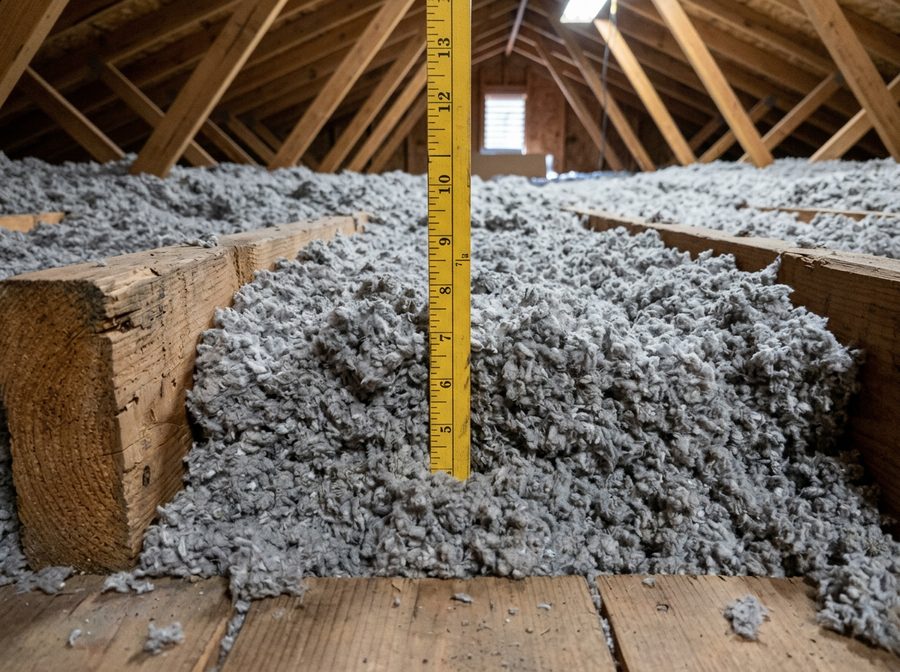
- Post-job R-value: R-60 or higher. After installation, your attic must reach R-60 minimum across the full attic floor. Most Denver homes end up somewhere between R-60 and R-70 after a well-executed blow-in job. We confirm actual depths with measurement probes across the entire attic before we pack up.
Why R-60? Colorado’s climate zone calls for higher attic insulation levels than many parts of the country. Denver sits at around 5,400 feet elevation with cold, dry winters and a wide seasonal temperature range. Getting to R-60 means your furnace or heat pump isn’t compensating continuously for heat escaping through the ceiling, and that difference shows up directly in your gas bill every month from October through April.
BPI-certified contractors understand how to calculate settled R-value versus installed depth – which is what Xcel audits. An attic that was blown to R-49 five years ago may measure considerably lower today due to settling, which can actually open up rebate eligibility on homes where the homeowner assumed they were already above the threshold.
From the Field: A 1972 Arvada Split-Level
Last week we were in a 1972 split-level in Arvada. The attic was at R-11 – original fiberglass batts, compressed and useless. That home qualified for the full $1,250 Xcel rebate plus an additional $600 heat pump bonus the owner didn’t even know existed. We ran the baseline blower door test, sealed the attic penetrations, and blew the attic from R-11 to R-65. Total rebate package for that homeowner: $1,850 before the Whole Home Efficiency bonus was applied. She had no idea the heat pump bonus was available until we walked her through the stacking math during the assessment.
Why Does the Xcel Attic Rebate Require Air Sealing?
Xcel requires air sealing alongside attic insulation because insulation alone doesn’t stop air movement through gaps – and those gaps are often the biggest source of heat loss in Denver homes.
Here’s where the attic insulation rebate differs from what a lot of homeowners expect: you can’t just blow in insulation and submit the paperwork. Xcel requires air sealing work alongside attic insulation, with a blower door test conducted before and after the combined project to verify that air leakage was reduced.
The blower door test measures the total air leakage through your home’s envelope – the combined effect of every gap, crack, and penetration in the building shell. For the attic insulation rebate to be approved, the post-job test must show a measurable reduction compared to the pre-job baseline. This isn’t a separate rebate bolted onto the attic project; it’s a built-in requirement of the attic insulation rebate itself.
Why does Xcel require this? Because insulation alone doesn’t stop air movement through a building. A well-insulated attic floor that still has unsealed gaps around recessed light fixtures, plumbing penetrations, top plates, and the attic hatch will still lose heat through those gaps year-round. Air sealing the attic before blowing in the insulation addresses the actual mechanism of heat loss, and that’s what the blower door test confirms was done correctly.
Read more about the standalone air sealing rebate, including how CFM50 reduction requirements work, in our blow-in insulation rebate guide.
What Insulation Types Qualify for the Xcel Attic Rebate?
Blow-in cellulose, loose-fill fiberglass, and batt insulation all qualify, as long as the attic starts at R-24 or below and ends at R-60 or higher.
Xcel’s program does not mandate a specific material type for attic insulation. What matters is that the installed insulation achieves R-60 or higher in the finished attic floor. The most common qualifying options are:
- Blown-in loose-fill fiberglass: Fast to install, settles to a consistent depth over time, and is widely available from multiple manufacturers in the Denver market. Qualifies at standard installed densities when depth is confirmed.
- Blown-in cellulose: Made from recycled paper treated with borate compounds for fire and pest resistance. Slightly denser than fiberglass by volume, which makes it effective at filling irregular joist bays and around obstructions. Also qualifies.
- Fiberglass batts: Less common for attic retrofits because of installation complexity – getting batts to lie flat, unfaced, across an existing attic floor without gaps is difficult and the air sealing component is harder to achieve. Can qualify when installed correctly.
- Open-cell spray foam in specific configurations: Can qualify in some attic floor applications, but has nuances depending on whether it’s applied to the floor assembly or the roof deck. See our blow-in insulation page for the full breakdown of spray foam and rebate eligibility.
At Insulation Nation, we use blown-in insulation for the large majority of attic jobs in Denver. It fills every corner of the attic floor, handles irregular joist configurations without gaps, and achieves consistent, verifiable depth across the entire installed area – which is exactly what the rebate application needs to show.
Attic R-Value Reference Table
| Existing Attic R-Value | Qualifies for Rebate? | Required Post-Job R-Value | Max Rebate (Gas-Heated Home) |
|---|---|---|---|
| R-0 to R-11 (no insulation or minimal) | Yes | R-60 or higher | Up to $1,250 |
| R-11 to R-19 (partial older insulation) | Yes | R-60 or higher | Up to $1,250 |
| R-19 to R-24 (borderline, must be confirmed below R-24) | Yes, if measured at or below R-24 before work starts | R-60 or higher | Up to $1,250 |
| R-25 or higher | No | N/A | $0 |
Real Cost and Savings Example: 1,500 Sq Ft Denver Attic
Here’s a realistic scenario for a Denver home with a 1,500 square foot attic currently sitting at R-13. This is a common starting point for homes built in the late 1970s or 1980s in neighborhoods like Centennial, Parker, Westminster, and Arvada – areas where builders installed some attic insulation but not enough by today’s standards.
Scope of work:
- Pre-job blower door test to establish baseline CFM50 reading
- Air seal all attic penetrations: recessed light fixtures, plumbing stacks, HVAC ducts and boots, top plates, and the attic hatch
- Blow cellulose or fiberglass insulation from R-13 up to R-60 across the full 1,500 square foot attic floor
- Post-job blower door test to document air leakage reduction
- Full rebate documentation and submission
Typical installed project cost in Denver: $2,800 to $4,200, depending on attic accessibility, number of penetrations requiring air sealing, and existing insulation conditions.
Xcel rebate received: Up to $1,250 (gas-heated home, air leakage reduction confirmed)
Estimated net out-of-pocket cost after rebate: $1,550 to $2,950
Estimated annual heating savings: $300 to $600 per year for a 1,500 sq ft Denver home moving from R-13 to R-60. Actual savings vary based on current utility rates, thermostat setpoints, duct leakage, and home configuration.
Simple payback period after rebate: 3 to 7 years, after which the ongoing savings are pure financial return for the life of the insulation (30+ years for blown-in materials).
If you also qualify for the Whole Home Efficiency (WHE) bonus – which adds 25% on top of standard rebates when you complete three or more qualifying measures within two years – the numbers look even better. The $1,250 attic rebate becomes up to $1,562.50 with the WHE multiplier applied. Full details are in our 2026 Xcel rebate amounts guide.
What Are the Most Common Reasons Attic Rebates Get Denied?
Missing pre-job documentation is the single most common denial reason – if the contractor didn’t measure R-value before work started, there’s nothing to prove the attic qualified.
We’ve processed applications for more than 2,000 homes and seen rebates come back denied for a repeating set of reasons. Knowing these upfront is the clearest way to understand why the steps in our process exist:
- Pre-job R-value not documented before work started: If the contractor didn’t measure and record the existing R-value before insulation was installed, there’s no way to prove the attic was below R-24 when the project began. This is a straightforward denial.
- No blower door test performed: Xcel requires pre- and post-job blower door testing for attic insulation rebate applications. Contractors who skip this step, or who only do one of the two required tests, can’t meet this documentation requirement. Automatic denial.
- Post-job R-value didn’t reach R-60: Some contractors quote the project at R-49 (which is lower than Denver’s recommended level but was a common target in earlier program years). If the post-job measurement comes in below R-60, the rebate doesn’t qualify regardless of how much insulation was added.
- Contractor was not enrolled as an active Trade Ally at the time of installation: Even a single day of lapsed enrollment can disqualify the project. There is no retroactive fix.
- Rebate application submitted after the 90-day window: Applications must be submitted within 90 days of project completion. Late submissions are denied without exception.
- Invoice didn’t include required program details: Xcel has specific invoice requirements. Generic contractor invoices that don’t include square footage, R-value details, or Trade Ally reference numbers often come back for revision – or are denied outright if the revision window passes.
How to Claim the Attic Insulation Rebate: Step by Step
When you work with Insulation Nation, here’s exactly what happens:
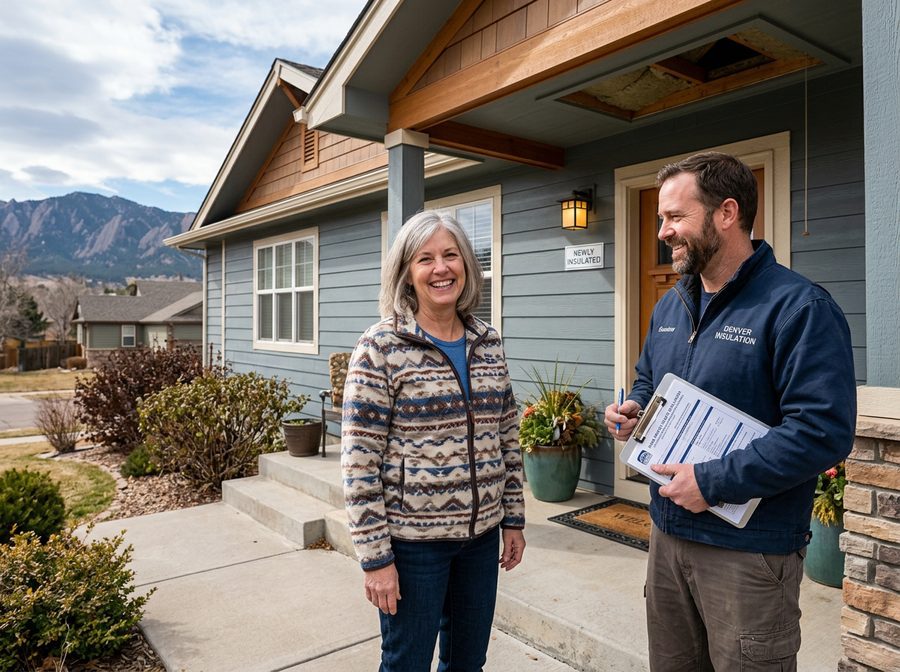
- Free home assessment: We visit your home, measure your existing attic R-value, inspect air sealing needs and access conditions, and give you a complete project quote with the expected rebate amount.
- Pre-job blower door test: Before any installation begins, we conduct a baseline blower door test and record your CFM50 reading. This baseline is required for the rebate application.
- Air sealing: We seal around all attic penetrations – recessed lights, plumbing stacks, HVAC boots, top plates, and the attic hatch – before insulation goes in. This is the step that makes the blower door improvement possible.
- Blow-in insulation installation: We install blown-in material across the full attic floor, using measurement probes throughout to confirm we’re hitting R-60 or higher at every point.
- Post-job blower door test: We retest the home to document the air leakage reduction. This second reading goes directly into the rebate application.
- Complete rebate submission: We compile all required documentation – pre/post R-values, both blower door readings, the itemized invoice, and our Trade Ally credentials – and submit the full package to Xcel. You receive a check from Xcel, typically within 6-10 weeks of our submission.
You fill out zero forms. You call no one at Xcel. There is no portal to log into. We handle the entire submission.
Get Your Attic Insulation Rebate Started
If your Denver attic is sitting below R-24, you have a real opportunity on the table – up to $1,250 back from Xcel Energy, plus significantly lower heating bills for years to come. The first step is a free assessment to confirm your current R-value and set up the project correctly from the beginning.
Visit our attic insulation page to learn more about our full process and see examples from completed Denver-area jobs.
Call (720) 410-9414 – we serve Denver and 40+ Front Range communities. BBB Accredited, BPI Certified, 4.9/5 on Google with 2,000+ homes insulated across the metro.
Don’t schedule the installation before you talk to us. The attic insulation rebate requires pre-job steps – measurement and baseline testing – that have to happen before work starts or the rebate is forfeit. Call (720) 410-9414 and we’ll walk you through the entire process before anything is scheduled.